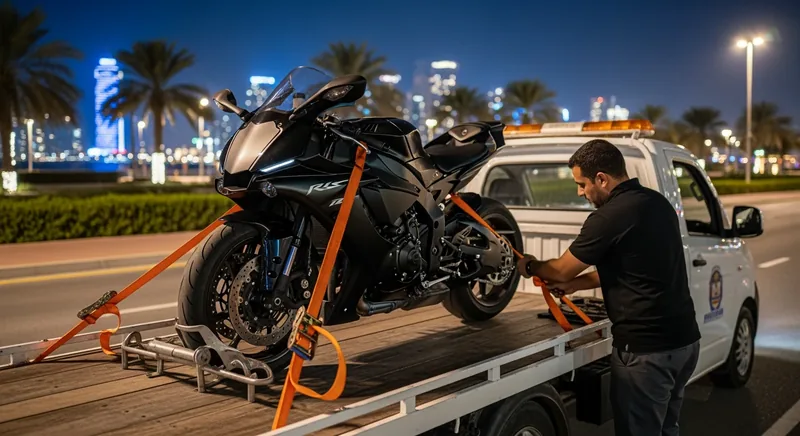
Why motorcycles need different recovery equipment
A car has a chassis. It has factory recovery points designed for towing. It has a spare wheel mount, a tow ball mount, and an owner's manual diagram showing exactly where to pull from. A motorcycle has none of those things. There is no chassis hook, no factory tow eye, no rated lifting point. Every part of a bike that looks pullable — the handlebars, the front fork, the rear sub-frame, the swingarm, the side stand — is either fragile or directly connected to the bike's geometry in a way that strapping the wrong way will bend or break it. Bike recovery is therefore a specialist discipline: the bike has to be loaded upright onto a flatbed or trailer using a wheel cradle, then secured with four soft straps that grip the right parts (front fork tubes, rear sub-frame corners) and avoid the wrong parts (handlebars, fairings, bodywork).
The cradle and soft strap system
The standard bike recovery setup uses a foldable wheel chock — a metal frame that grips the front wheel from both sides and holds the bike upright once it is rolled into position. The bike is rolled up the trailer ramp, the front wheel slots into the chock, and the chock locks. From there, four soft straps are attached: two from the front (looped around the bottom of the front fork tubes, just above the brake calipers, anchored to the trailer floor in front of the bike at a forward angle) and two from the rear (looped around the rear sub-frame just below the seat, anchored to the trailer floor behind the bike at a rearward angle). The four straps create cross-tensioning that keeps the bike upright and prevents lateral movement. Soft cloth straps (typically 1-tonne working load each) protect paint and fairings; ratchet straps with metal hooks would scratch.
Why we never strap to the handlebars
This is the single most common amateur mistake. Strapping a bike's handlebars to the trailer floor compresses the front suspension and the head-stock bearings. Over a long tow this can wear the steering bearings and damage the fork seals. On older bikes with weaker handlebar mounts it can also bend the bars. The correct anchor is the front fork tube itself, just above the brake caliper, where the suspension is rigid. Always.
Sport bikes versus cruisers — different cradles
Sport bikes (Yamaha R1, Suzuki GSX-R, Ducati Panigale, Kawasaki ZX-10R, Honda CBR Fireblade) have low-clearance fairings that scrape the ramp at standard tilt angles. We use a low-clearance ramp (around 8 degrees instead of 14) and lift the front wheel into the cradle to clear the belly fairing. Cruisers (Harley-Davidson Road King, Goldwing, BMW K1600, Indian Chief, Triumph Bonneville) are heavier and wider, often 280–400 kg. They need a wider cradle sized for the broader front tire, and four-point soft strapping with rear straps anchored further apart to control the wider centre of gravity. Scooters (Vespa, Honda PCX, Yamaha NMAX, Suzuki Burgman) use a smaller cradle and two-point strapping. Adventure bikes (BMW GS, KTM Adventure, Honda Africa Twin) sit in the middle — taller stance, off-road tyres, but standard sport-bike cradle dimensions.
Track-day and pit-lane recovery
Yas Marina Circuit and Dubai Autodrome both host motorcycle track days. When a rider goes down on the circuit, the marshals push the bike to the pit lane and the rider needs transport home. We provide standby pit-lane recovery for several track-day operators. The procedure is different from public-road recovery: the bike usually has crash damage (broken bar end, scuffed fairings, possibly leaking fluid), the rider may be assessed by the medical team, and the bike has to be loaded carefully without making the damage worse. Pre-arranged standby contracts mean a recovery van is already at the circuit during track-day hours — response time from track call to bike on the trailer is usually under 10 minutes.
Delivery bike fleets — Talabat, Careem, Deliveroo
The largest single fleet category in Dubai by vehicle count is delivery bikes — Talabat, Careem, Deliveroo, Noon Food and other delivery operators run thousands of small motorcycles and scooters across the city. When a delivery bike breaks down, the rider needs immediate replacement to keep order delivery flowing, and the broken bike needs transport to the operator's workshop. We run fleet recovery contracts for several delivery operators with priority dispatch (their calls jump our queue), monthly invoicing, and consolidated pickup runs (one truck collects multiple broken bikes from a route). If you operate a delivery fleet in Dubai, contact us about standby contracts.
Heavy bike towing — Goldwing, K1600, big tourers
Heavy touring bikes weigh 350–420 kg unloaded and over 500 kg with luggage and a passenger. They need a wider cradle, four-point strapping with the rear straps anchored further outward to compensate for centre-of-gravity, and a longer trailer deck. The Honda Goldwing GL1800 and BMW K1600 are the two most common heavy tourers in Dubai. We carry purpose-built heavy-bike trailers with reinforced cradles and 2-tonne soft strap kits. Loading a heavy tourer takes about 20 minutes including the careful approach up the ramp — a sport bike loads in 8 minutes. The pricing reflects the equipment difference and operator time.
Adventure bikes and off-road recovery
BMW GS series, KTM Adventure, Honda Africa Twin, Suzuki V-Strom — these bikes are designed for off-road use and frequently end up in the desert during weekend trips. Off-road bike recovery is a different problem from on-road bike towing. The bike may be in soft sand, on a slope, or down in a wadi. We use lighter recovery vehicles for off-road bike retrieval (4×4 with bike-specific trailer) and may need to ride the bike back to firmer ground before loading. For desert bike recovery the dispatcher asks the same questions as for car desert recovery: GPS coordinates, what3words address, or detailed landmark plus distance.
Common bike scenarios we get dispatched for
- Won't start — dead battery, fuel pump fault, fouled spark plug. Often resolved on-spot with mobile mechanic kit; no tow needed.
- Crash recovery from public road — minor or major. Police report needed for accidents; bike loaded carefully to avoid worsening damage.
- Track-day pit-lane recovery — Yas Marina or Dubai Autodrome. Standby contracts mean fast response.
- Long-distance enthusiast tow — bike that's not registered for the road, project bike pickup, garage move.
- Delivery fleet breakdown — Talabat, Careem, Deliveroo. Priority dispatch via fleet contract.
- Adventure bike desert stuck — GS or Africa Twin in dunes. 4×4 dispatch with bike trailer.
- Inter-emirate transport — Sharjah/AD/RAK delivery for sale, workshop or relocation.
- Track day "pickup from house" + return — pre-booked round-trip transport for track-day enthusiasts who drive a sports car to the circuit and want their bike there.
- Vintage / classic bike — older British and Italian bikes (Triumph Bonneville, Norton, Moto Guzzi, Vespa). Slow loading, soft straps, paint protection.
- Insurance bike total-loss pickup — accident-damaged bike to insurer-approved scrap or workshop.
Soft strap selection
Strap quality matters. We use 1-tonne working load soft cloth straps with a stitched loop on each end (no metal hooks that can scratch paint). The loop is pulled through itself around the fork tube or sub-frame in a "girth hitch" configuration that grips firmly without crushing. Each strap has a working load rating (1 tonne typical) and a breaking strength rating (3+ tonnes). The working load is the safe everyday tension; breaking strength is the failure point. We never load a strap above its working load. For heavier bikes (cruisers, tourers) we use 1.5-tonne or 2-tonne straps.
Bike-specific damage prevention
Three areas to protect during loading:
- Fairings and bodywork — scratch-prone paint and decals. Soft straps only, no metal-on-paint contact, ramp surface clean.
- Front and rear suspension — never compress the front suspension fully against the cradle (use the front fork tubes as anchor, not the trailer floor pulled tight). Allow 1–2 cm of fork extension travel during transport so road bumps are absorbed.
- Brake levers and bar ends — frequently scratched in amateur loading. Pad bar ends if any contact with trailer side walls is possible.
Insurance and accident bike recovery
For accident bikes the police report number is the critical document — required by every UAE insurer. We coordinate with Dubai Police at the scene, photograph the bike from all sides for pre-tow documentation (so any new damage is obviously new and not pre-existing), and forward the police report number to the insurer using your policy number. For our partner insurers — AXA Gulf, Sukoon, Orient, Emirates Insurance — direct billing means you do not pay cash up-front. For non-partner insurers you pay us directly and reclaim using our invoice and the police report copy.
Vintage and classic bike recovery
Older British, Italian and Japanese classics — Triumph Bonneville, Norton, Moto Guzzi, Vespa Primavera, original Honda CB series — get loaded slowly with extra paint protection. These bikes often have fragile paint, period-correct decals that cannot be replaced if scratched, and original components (chrome handlebars, leather seats) that need careful handling. Loading time is 25–30 minutes versus 8–12 minutes for a modern sport bike. The price reflects the time and care required.
Pricing structure
Bike recovery quotes depend on bike weight class, distance, time of day and any extras. Light scooter (under 150 kg — Vespa, PCX) is the cheapest tier. Standard motorcycle (150–250 kg — most sport bikes, mid-size cruisers) is the middle tier. Heavy touring (250+ kg — Goldwing, K1600, large Harley) is the higher tier. Vintage / classic adds a careful-handling premium. Track-day standby contracts have a fixed monthly retainer with reduced per-job rates. Quote on WhatsApp in 60 seconds — share the bike model, your location, and destination.
Goods-in-Transit insurance
Every recovery service should carry Goods-in-Transit (GIT) insurance to cover the customer's vehicle while it is in the recovery operator's care. We do, with cover for the full insured value of the bike. If anything happens to your bike between pickup and drop-off — extremely rare with proper soft-strap technique, but still — our insurance covers the repair or replacement cost. Always ask any recovery operator whether they carry GIT before handing over your bike.
Common rider mistakes during a breakdown
The biggest mistake is parking the broken bike on the side of a busy road shoulder without the side stand fully deployed and locked. Sport bikes' side stands can pop up if the ground is uneven, dropping the bike. Always deploy the stand on firm flat ground, and consider laying the bike on its side on grass if no firm ground is available (controlled "lay-down" causes less damage than uncontrolled fall). The second mistake is standing in traffic next to the bike — riders feel exposed and want to inspect the bike, but moving cars create real injury risk. The third mistake is amateur loading — friends and family can be more dangerous than helpful when loading a bike onto a pickup. If you have a friend with a pickup willing to help, brilliant — but only if your friend has actually loaded a bike before. Otherwise call us; the cost of getting the bike loaded properly is much less than the cost of a botched amateur load.
What to do while waiting
If your bike has stopped on a public road: switch on the hazard lights, deploy the side stand on firm ground, dismount on the kerb side (never traffic side), step well off the road behind the safety barrier, and WhatsApp our line with your live location pin. If you went down in an accident: stay still until you have been assessed — adrenaline can mask injuries — and call 999 for police and ambulance before calling recovery. If on the highway shoulder, do not stand next to the bike; passing trucks at 100+ km/h create real wind-blast and side-swipe risk.
Save the number for your bike too
Save +971 56 361 3657 in your phone now. WhatsApp at wa.me/971563613657. Average response time across Dubai is 30 minutes for bike recovery — same as cars. EN + AR dispatch 24/7. RTA-licensed operator with Goods-in-Transit insurance, in-house specialist bike trailers, soft-strap kit on every truck, and 4.8-star Google rating from 281+ reviews. The number works for cars, bikes, scooters and everything in between.