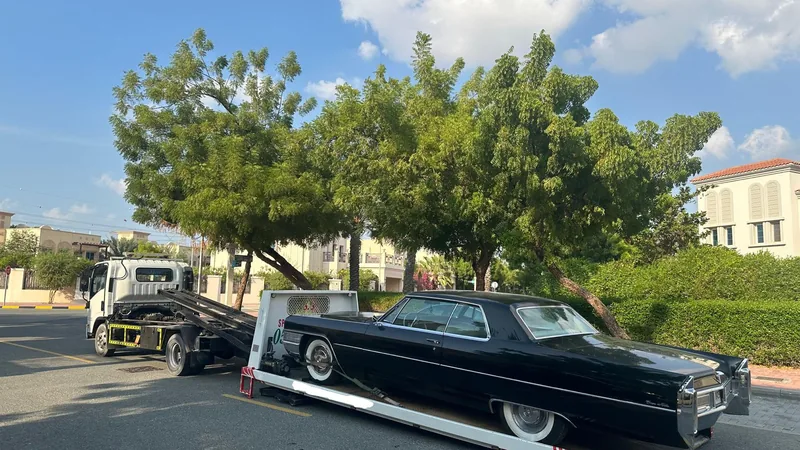
What heavy vehicle recovery actually involves
Heavy vehicle recovery in Dubai is the dispatch of specialised tow rigs to vehicles weighing over 3.5 tonnes — articulated lorries, tipper trucks, tankers, container trailers, full-size buses, and plant equipment. The equipment is different (10-tonne and 20-tonne hydraulic underlift recovery rigs and rotator cranes), the operator licensing is different (Class 5 UAE driving licence with heavy-vehicle endorsement plus RTA-issued heavy recovery permit), the paperwork is different (RTA road-blocking permits, police coordination for highway incidents, sometimes hazmat clearance for tankers), and the response logistics are different (heavy rigs are positioned at industrial-zone hubs in Jebel Ali, Al Quoz and DIP rather than spread across residential dispatch hubs). Heavy Recovery Dubai handles all of it.
The heavy fleet
Three core rig types cover most heavy recovery scenarios:
- 10-tonne recovery truck — hydraulic underlift sized for vehicles up to roughly 10 tonnes gross weight. Handles light commercial trucks, mid-size buses, mid-weight pickups, smaller tippers, larger Land Cruiser variants, panel vans, and damaged passenger cars in tight spaces.
- 20-tonne recovery truck — heavier hydraulic underlift for articulated lorries (the typical tractor-trailer combination), full-size buses, tankers, container trailers, heavy tippers, and plant equipment up to 20 tonnes gross weight. The 20-tonne rig is the workhorse of the heavy fleet.
- Rotator crane — vehicle-mounted rotating crane for lifting and righting overturned, rolled, or trapped vehicles. The rotator can lift, swing, and lower a heavy vehicle from any angle, making it the only practical solution for severe accident scenes where a vehicle is on its side or roof.
For ultra-heavy or specialised loads (above 20 tonnes, or unusual shapes like construction cranes), we coordinate twin-rig setups or sub-contract specialist hauliers depending on the job.
10-tonne vs 20-tonne — when to use which
Pricing and equipment match the gross weight of the casualty vehicle. Sending a 20-tonne rig to a job that a 10-tonne rig can handle wastes equipment and costs more; sending a 10-tonne to a 20-tonne job risks overloading the rig and damaging both vehicles. Quick rule:
- Vehicle gross weight under 10 tonnes → 10-tonne recovery rig is sufficient.
- Vehicle gross weight 10–20 tonnes → 20-tonne recovery rig.
- Vehicle weight over 20 tonnes or with unusual centre of gravity → twin-rig coordination or rotator crane.
- Rolled, overturned, or wedged vehicle (any weight) → rotator crane required.
The dispatcher asks for the vehicle make, model, and gross weight (printed on the vehicle's registration certificate or visible on the chassis plate) before dispatching to make sure the right rig arrives.
RTA permits and road-blocking authority
Heavy recovery on Dubai roads requires RTA-issued permits for road blocking, lane closure and highway incident clearance. Our heavy rigs carry these permits on board and our operators are trained on the procedures for closing a lane safely while the recovery is underway. For incidents on a Dubai-Abu Dhabi or Dubai-Sharjah highway segment, the relevant emirate's traffic authority is also notified. Police coordination is mandatory for any accident involving heavy vehicles — Dubai Police on 999 attend the scene, issue the report number, and direct the lane closures we carry out.
Roadside heavy breakdown — typical scenario
An articulated lorry hauling cement bags down E11 from Sharjah to Jebel Ali Port has its turbocharger fail on the inbound side at SZR Exit 39. The driver pulls onto the shoulder. Inbound morning traffic is heavy. The driver calls our line. The dispatcher sends a 20-tonne recovery rig from our Jebel Ali staging area (closer than from Al Quoz at this hour) and notifies Dubai Police and RTA. The recovery rig arrives in around 35 minutes, sets up hazard cones and warning signs 100 metres back from the casualty, attaches the hydraulic underlift to the lorry's front axle, lifts the front of the lorry off the ground (the trailer is detached and parked under traffic management until a separate prime mover collects it), and tows the prime mover to the customer's depot or workshop. Total scene time: around 45 minutes. Police clear the lane closure once the casualty is off-road.
Bus recovery — passengers come first
When a bus breaks down with passengers on board — common with tour buses heading to Hatta or transfer buses to AD airport — the recovery sequence prioritises passenger transfer before vehicle recovery. We coordinate a replacement bus to collect the passengers, then dispatch the heavy recovery rig to tow the broken bus. Passengers are never towed inside a bus on a recovery rig — that is illegal and unsafe under UAE rules. For tour operators with regular bus fleets we run standby contracts that include backup-bus dispatch as part of the package.
Articulated lorry recovery — prime mover and trailer
An articulated lorry has two parts: the prime mover (the front truck with the engine and cab) and the trailer (the cargo section that hooks to the prime mover via a fifth-wheel coupling). When the prime mover breaks down, two scenarios arise. Scenario A: the trailer is loaded with cargo. We tow the prime mover and arrange a separate prime-mover swap so a working tractor can connect to the trailer and complete the cargo delivery. Scenario B: the trailer is empty or can wait. We may tow both as a single combined unit (if the breakdown is mechanical and the prime mover steering still works) or detach and tow the prime mover alone (if the engine or steering is failed). The dispatcher asks the right questions to plan the right approach.
Tanker recovery — hazmat awareness
Tankers carrying fuel, chemicals or hazardous materials require special handling. Before any recovery work, the operator confirms the cargo type with the driver and reviews the dangerous goods documentation (the lorry must carry it). If the cargo is hazardous, additional safety measures apply: extra distance from open flames, additional warning signage, possible coordination with Civil Defence if a leak is suspected. We do not transfer hazardous cargo at the roadside — that is a job for specialist hazmat teams. We tow the tanker as a sealed unit to the designated handling depot or transfer yard.
Plant equipment recovery
Construction equipment — excavators, wheel loaders, forklifts, generators, mobile cranes — falls in the heavy recovery category. The equipment can be wheeled (forklifts, wheel loaders) or tracked (excavators, bulldozers). Wheeled plant is easier — we use a low-loader trailer or the 20-tonne underlift depending on weight. Tracked plant requires a low-loader trailer with ramps because the tracks cannot be towed on the road. For very heavy plant (large excavators above 25 tonnes, mobile cranes above 30 tonnes), we coordinate specialist haulier sub-contractors. Construction sites in Dubai South, Jebel Ali, DIP, Dubai Hills are our most common plant-equipment dispatch destinations.
Rotator crane recovery — overturned and rolled vehicles
The rotator crane is the specialist tool for accidents where a vehicle is on its side, on its roof, or wedged against a barrier. The rotator's vehicle-mounted crane can lift from any angle, swing the casualty back upright (carefully, to control any cargo shift inside), and place the vehicle gently back on its wheels for towing. Rotator work is slow and careful — a typical roll-over righting takes 30–60 minutes of crane work plus another 30 minutes of cleanup before the casualty is on the underlift for transport. For container-trailer rollovers at Jebel Ali Port, the rotator is essential: cargo cannot always be transferred on-site without first righting the trailer.
B2B fleet contracts and SLA
Heavy recovery is mostly a B2B service. Our customers are logistics fleets, tour operators, construction firms, port operators, and major UAE businesses. Standard fleet contract terms include: priority dispatch (your call jumps the queue ahead of standard customers), fixed per-job rates agreed in advance based on vehicle types in your fleet, monthly invoicing with detailed job logs, dedicated account manager for direct contact and incident coordination, SLA-backed response time (typically 30–45 minutes for Dubai zones, 60–90 minutes for Abu Dhabi), and specialist standby at agreed times or events (e.g. tour-day standby for tour operators, port-shift standby for logistics firms). Quote on WhatsApp or email — pricing depends on fleet size, vehicle types, expected call volume and SLA tier.
Insurance and damage liability
We carry Goods-in-Transit insurance on every heavy job — covering casualty vehicles in our care during pickup, transit and drop-off. We also carry commercial liability insurance for the recovery operation itself (any damage caused by our equipment or operators during the scene work). For accident scenes on public roads, the casualty vehicle's own insurer pays the recovery cost via direct billing if the policy covers it. For B2B fleet contracts, the fleet operator's insurance handles claims. The paperwork is straightforward: police report copy, our recovery invoice with photos, the insurer settles per policy.
Heavy operators — who they are
Heavy recovery operators are specialised. Our heavy operators carry: a UAE Class 5 driving licence with heavy-vehicle endorsement, an RTA-issued heavy recovery permit, hazmat awareness training (for tanker work), basic first-aid certification (for accident scenes), and have completed our internal training programme covering 10/20-tonne underlift technique, rotator crane operation, RTA-permit road-blocking procedure, police coordination, multi-vehicle accident scene management, and customer communication during long-duration recoveries. Heavy operators are full-time employees, not subcontractors — the equipment is too specialised and the liability too high to use third-party drivers.
Common heavy scenarios
- Articulated lorry mechanical breakdown on E11, E311 or E611 highway segments.
- Construction equipment breakdown on a Dubai South, Jebel Ali, DIP or Dubai Hills construction site.
- Bus breakdown with passengers on tour route to Hatta, AD airport or RAK resorts.
- Container trailer detachment at Jebel Ali Port — broken kingpin, blown air bag, or fifth-wheel failure.
- Tanker mechanical failure on inter-emirate transit — careful coordination with cargo type.
- Roll-over accident at SZR exit ramps or roundabouts — rotator crane to right and tow.
- Heavy SUV recovery from accident scene — Land Cruiser, Patrol, GLS in tight access points where the 10-tonne rig is the right tool.
- Plant equipment relocation — moving a wheel loader or excavator between construction sites.
Pricing variables for heavy
Heavy recovery is more expensive than passenger-vehicle recovery for obvious reasons: bigger rigs, longer setup, RTA permits, multiple operators on scene, and longer transit times. The five quote variables: casualty vehicle weight class (10-tonne vs 20-tonne rig matched), distance from origin to destination (often inter-emirate or to industrial yards), complexity (straight breakdown vs accident scene with rotator crane vs hazmat coordination), time of day (small night surcharge), and extras (replacement bus dispatch, trailer detachment and separate handling, scene cleanup). Quote on WhatsApp or email in 60–90 seconds with the full figure.
What to tell us when calling for heavy recovery
For fast accurate dispatch, share these eight pieces of information:
- Casualty vehicle make, model and registration plate
- Gross weight (from registration certificate or chassis plate)
- Cargo type (if any) — and dangerous goods documentation if hazmat
- Exact location — live WhatsApp pin or GPS coordinates
- What's wrong (mechanical, accident, rolled, stuck, blocked)
- Whether police are already on scene (police report number if issued)
- Whether passengers are involved (if it's a bus)
- Destination (workshop, depot, port, scrap yard, another emirate)
Why we are different from generic heavy operators
Most heavy recovery operators in Dubai are small fleets with one or two trucks. We run a multi-rig fleet with positioned staging across the city, full RTA permit cover, in-house operators (no subcontracting), Goods-in-Transit and commercial liability insurance, fleet-contract account management, and 4.8-star Google rating from 281+ reviews. For B2B customers the predictability matters — knowing that the rig will arrive within SLA, the operator is properly trained, the paperwork is complete, and the invoice matches the quote.
The B2B contact
For one-off heavy recovery jobs, WhatsApp +971 56 361 3657 with the eight pieces of information above. For B2B fleet contracts, monthly retainer agreements, port standby, tour operator backup, or construction-site relationships, contact us via WhatsApp or email [email protected] to speak with the fleet account manager. SLA terms, pricing, and standby coverage are bespoke to fleet size and expected call volume. EN + AR dispatch 24/7. RTA-permitted heavy fleet ready across Dubai, Abu Dhabi, Sharjah and inter-emirate routes.