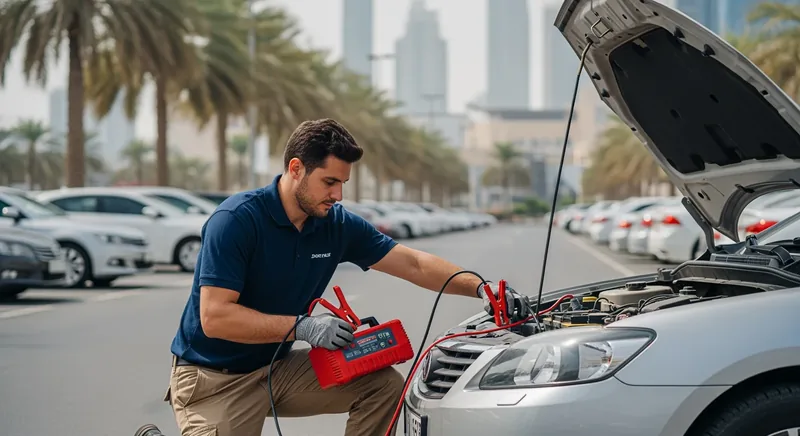
Why UAE batteries die so fast
If you have lived in Dubai for more than a couple of summers you already know the pattern: the car starts fine in March, struggles a bit in May, and refuses to crank one morning in July. The reason is heat. UAE summer ambient temperatures regularly cross 45°C, and the asphalt-radiated temperature inside an engine bay can exceed 70°C during peak afternoons. Lead-acid batteries — the chemistry inside almost every UAE car — lose electrolyte faster, corrode internally faster, and lose cold-cranking amps (CCA) faster at those temperatures than they do anywhere in Europe or North America. The practical consequence: average car battery life in Dubai is 2–3 years, compared to 4–5 years in cooler climates. Modern start-stop systems, which cycle the battery hundreds of times per day, shorten the life further.
What our battery service does
Our mobile battery service brings the workshop to your location — home driveway, office parking, mall valet, hotel valet, roadside, basement parking, anywhere with vehicle access. The technician arrives with a portable lithium jump pack, a CCA test meter, a stocked van of replacement batteries (all major brands, all common UAE sizes), and proper safety gear. The procedure is: connect, jump-start, test CCA, advise honestly whether the battery will hold or needs replacement, fit a new battery if needed, take the old one for proper recycling, and you drive away. Total on-spot time is usually 15–25 minutes for a jump-start with replacement, or 5 minutes for jump-start alone if the battery is healthy.
Should you jump-start or replace?
This is the single most common question. The honest answer depends on three measurable factors:
- Age: if the battery is under 18 months old and recently had a parasitic drain (interior light left on, dome light fault, USB charger drawing current), a jump-start usually revives it and you can drive on for months. If the battery is over 2 years old, a jump-start is a temporary fix and you should replace within days.
- Cold-cranking amps (CCA): we test CCA on the spot with a digital tester. If the reading is within 80% of the rated value, the battery is healthy and a jump-start is the right call. If it is below 60% of rated, replacement is the only durable answer.
- Visual signs: bulged or cracked casing, white or green corrosion on terminals, cloudy or low electrolyte (visible on flooded batteries with translucent casings) — all are signs to replace, not jump.
The technician tells you the test result honestly. If the battery passes, you save money and drive on. If it fails, the new battery is fitted on the spot.
AGM vs flooded — which type for Dubai
Two main lead-acid chemistries dominate the UAE market: flooded lead-acid (cheaper, traditional, suitable for older cars without start-stop systems) and AGM (Absorbent Glass Mat) (more expensive, sealed, better at heat tolerance and start-stop cycling). For Dubai conditions we default to AGM unless your car specifically requires flooded. AGM handles heat 30–40% better than flooded, lasts longer in start-stop cycling environments, and is the OEM specification for almost every modern Mercedes, BMW, Audi, Porsche, and high-end Toyota or Nissan. The price premium for AGM is around 30–50% over flooded but the longer life usually offsets the difference.
Brand comparison — what we stock
| Brand | Origin | Warranty | Best for |
|---|---|---|---|
| Amaron | India (Amara Raja) | 2-3 years | Best value AGM for mid-tier sedans |
| Varta | Germany (Clarios) | 3 years | OEM for VW, Audi, BMW, Mercedes |
| Bosch | Germany | 3 years | OEM for Mercedes, Audi, Porsche |
| ACDelco | USA (GM) | 2 years | OEM for GM, Cadillac, Chevrolet |
| Exide | USA / India | 2 years | Budget option for older cars |
| Yuasa | Japan | 2 years | Heavy commercial, trucks, vans |
| Banner | Austria | 3 years | Premium AGM for European luxury |
We do not sell unbranded batteries — quality control on no-name imports is unreliable and a bad battery installed today is a tow next month. Stick to known brands with valid UAE warranty.
Battery sizes and group numbers
Every car has a battery size specification — usually printed on the existing battery, in the owner's manual, or on a sticker on the engine bay. Common UAE sizes include Group 24F (most American sedans), Group 27 (Toyota Camry, Honda Accord), Group H7 / DIN 75 (most Mercedes, BMW, VW, Audi), Group H8 / DIN 95 (larger German luxury and AGM start-stop), Group D31 (Land Cruiser, Patrol, Hilux). Mixing sizes (using a smaller battery than spec) reduces cold-cranking power and life. Mixing chemistries (using flooded where AGM is required) confuses the car's charging system on modern start-stop vehicles. We bring the right size and chemistry for your car.
EV 12V auxiliary battery
Yes, electric vehicles have batteries. Two of them, in fact. The big high-voltage pack (the one with hundreds of cells) powers the motor and the wheels — that is the one Tesla and Lucid talk about in marketing. But every EV also has a small 12V auxiliary battery (lead-acid AGM or sometimes lithium) that powers the electronics, the locks, the dashboard, and the contactor that connects the high-voltage pack. When the 12V dies, the car cannot power on, the doors may not unlock, and the high-voltage pack stays disconnected even though it has plenty of charge. Symptoms: dashboard goes black, doors won't open electronically, charging port won't open. We carry OEM-spec 12V batteries for Tesla, Lucid, BYD, Polestar, Mercedes EQ, BMW i and Audi e-tron. Replacement procedure follows the manufacturer's official tow-mode and 12V-replacement steps so warranty is preserved.
What kills batteries early in Dubai
Ranked by frequency of damage we see in our calls:
- Heat: the dominant factor. Park in shade where possible. Underground basement parking extends battery life noticeably.
- Short trips: a 5-minute drive doesn't fully recharge the battery from start-up draw. Repeated short trips drain the battery progressively. Take the car for a 30-minute drive once a week if you are mostly running short hops.
- Parasitic drain: a faulty interior light, a USB charger left plugged in, an aftermarket alarm or dashcam wired incorrectly — all draw current 24/7 and over a couple of weeks of leaving the car unused they kill the battery.
- Loose connections: battery terminals corrode in the UAE summer humidity (yes, it gets humid even at 45°C). Corroded terminals reduce charging current and create voltage drops. Visual check at every service.
- Wrong battery for the car: a non-AGM battery in a start-stop car wears out within a year. Always match OEM spec.
- Faulty alternator: if the alternator is undercharging, the battery never fully recharges and dies prematurely. We test alternator output during every battery service call.
How to extend your battery's life
Practical steps that genuinely help. Park in shade or underground wherever possible — direct sun is the single biggest killer. Drive for at least 20 minutes once a week to fully recharge if you are mostly doing short trips. Don't leave electrical accessories on with the engine off (cabin lights, AC blower, radio). Disconnect the battery if leaving the car unused for more than 3 weeks (e.g. summer holidays abroad). Check terminals for corrosion every 6 months — clean with baking soda solution if needed. Use a trickle charger (around AED 200 from any auto store) if the car sits idle frequently — keeps the battery topped up without overcharging.
Mobile fitting procedure
The replacement procedure on-site takes about 15–20 minutes for a standard sedan and 25–30 minutes for an AGM-equipped luxury car or EV (which often need a battery registration / coding step using a diagnostic tool). Steps: technician parks the service van adjacent, opens the bonnet, disconnects the negative terminal first (always — sparking on positive while negative is connected can cause a fire), disconnects positive, removes the battery clamp, lifts the old battery out, places the new battery in, fits the clamp, connects positive first, negative last, performs a battery registration via OBD-II if required by the car's BMS (battery management system), and verifies the dashboard shows the correct charging voltage. Old battery is taken away for proper recycling.
Battery recycling — why it matters
Lead-acid batteries are highly recyclable — over 95% of the lead, plastic and acid is reusable. UAE environmental regulations require licensed disposal of used batteries. Our service includes free old-battery removal — we never leave the dead battery with the customer. The collected batteries are taken to a UAE-licensed recycler where the lead is smelted, the plastic casings are pelletised for new battery casings, and the sulfuric acid is neutralised and disposed safely. Throwing a dead battery in regular waste is illegal and environmentally damaging.
Warranty terms
Our replacement batteries come with the manufacturer warranty — 2 years for most flooded batteries, 3 years for AGM and premium brands. Warranty covers manufacturing defects only — not damage caused by faulty alternator (overcharging), faulty wiring (short-circuit), accident damage, or improper handling. If your battery fails within the warranty period from a manufacturing defect, we replace it free of charge. The warranty card is provided at fitting.
Pricing transparency
Battery service pricing varies by vehicle type and battery brand/size. Smaller batteries (Group 24F, Group 27 for Camry/Corolla) are the cheapest end of the range. Larger AGM batteries (H8/DIN 95 for premium German luxury) are at the higher end. EV 12V batteries (smaller in physical size but specialised chemistry) sit in the middle. Mobile fitting fee is included — we do not bill extra for coming to your location. Quote arrives on WhatsApp in 60 seconds with the exact figure.
Insurance and battery
Some comprehensive insurance policies include battery service as part of roadside benefits. If your policy covers it, send us your policy number on WhatsApp and we direct-bill the insurer. For non-included policies, you pay us directly. Some warranty extensions on new car purchases also include battery replacement for the first 2–3 years of ownership; check your dealer warranty before buying a battery from us.
Common scenarios we get dispatched for
- Won't crank in the morning — overnight parasitic drain. Jump-start, test CCA, replace if needed.
- Slow crank, weak starter — battery passing CCA threshold but barely. Replace recommended.
- Dashboard battery warning while driving — usually alternator fault, not battery. Diagnose, advise on alternator replacement.
- EV won't power on — 12V auxiliary battery dead. Replace 12V; the high-voltage pack is fine.
- Battery boiling smell or visible bulging — overcharging or internal failure. Replace immediately, do not jump.
- After-airport-parking dead battery — long-term parking + Dubai heat. Common after 2-week holiday returns.
- New car battery already failed in 1 year — usually wrong-spec battery sold by previous fitter. Replace with correct spec.
Heat-aware battery care calendar
March: spring inspection — clean terminals, check load test. May: pre-summer load test — replace any battery showing weakness before peak heat. July–September: peak risk — keep jumper cables in the boot, save our number. October: post-summer review — many batteries that survived September fail in October cool-down cycles. December–February: easy months for batteries — but watch parasitic drain on cars sitting unused over holiday breaks.
The number to save
For battery service anywhere in Dubai or across the UAE, save +971 56 361 3657. WhatsApp wa.me/971563613657 for the fastest response — send the make, model, year, and your location, and we send a transparent quote in 60 seconds. Mobile fitting at your home, office, mall, hotel valet or roadside. EN + AR support 24/7. Free old-battery recycling. RTA-licensed operator with 4.8-star rating from 281+ Google reviews.
What to do if you suspect alternator (not battery) failure
One symptom that often gets misdiagnosed as a dead battery is alternator failure. The clue: the dashboard battery warning light comes on while you are driving, the headlights dim noticeably under acceleration, and accessories (radio, AC blower) cut out intermittently. A dead battery dies sitting overnight; a failing alternator dies during the drive itself. If you suspect alternator, do not jump-start and try to drive home — the battery will run flat within 15–30 minutes of driving without alternator support, leaving you stranded somewhere worse. Pull over to a safe spot, switch off non-essential electrics, and WhatsApp us. We dispatch the mobile mechanic kit with multimeter to test alternator output before deciding whether to replace battery, replace alternator, or tow.
Battery installation and registration on modern cars
Modern luxury cars (most BMWs from 2008+, Mercedes from 2010+, Audi from 2010+, recent Porsches and high-end Toyotas) require battery registration after replacement. The car's battery management system (BMS) tracks the battery age and adjusts the charging profile accordingly. Without registering the new battery via OBD-II, the BMS continues to charge at the old battery's profile and the new battery degrades fast — you can lose 30–40% of expected lifespan. Our technicians carry the OBD-II tools to register batteries for all major brands; the registration takes 2–3 minutes after physical installation. If you bought a battery from a generic auto store and they did not register it, the warranty calculation may also be invalid.