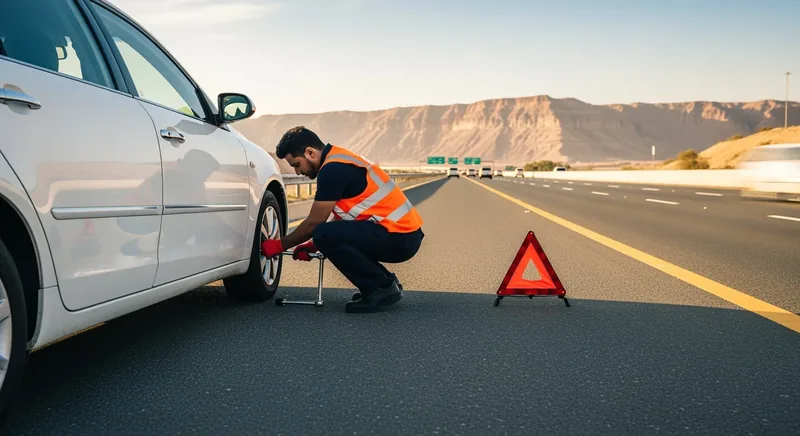
What roadside assistance solves that towing does not
Roadside assistance is the dispatch of a mobile technician who fixes your car on the side of the road without towing it. The fix usually takes 10–30 minutes and gets you back on the move. Towing only makes sense when the underlying problem cannot be solved with portable tools — engine seized, gearbox locked, accident damage, EV thermal alert. For everything else, roadside is faster and cheaper. Roadside Assistance Dubai covers the full range of on-spot fixes: lockout, fuel delivery, flat tire change, jump-start, mobile mechanic diagnostic, and winch-out from sand, mud or ditch. Calls are taken 24/7 and average arrival across Dubai is around 25–30 minutes.
The six core roadside services we run
Each service has its own equipment, technician training, and dispatch profile. Below is what each one actually involves.
1. Car lockout service
You locked the keys in the car or the smart key fob died. We arrive with non-destructive entry tools — a slim jim (modern stainless steel, soft-coated to avoid window scratching), a wedge and rod air-pump tool (preferred for newer cars with side airbags built into the door), and an electronic decoder for keyless cars. No drilling, no broken windows, no damage. Most lockouts are resolved on-spot in 5–15 minutes. For high-security cars (some BMW and Mercedes models with thicker glass and tighter door seals), the operator may need a touch longer; we tell you upfront on WhatsApp before dispatch. For dead smart-key fobs we can sometimes boost the fob temporarily with a portable battery so the door unlocks, but you'll then need to drive to a dealer for a fob battery replacement.
2. Fuel delivery
You ran out of fuel — common on E11 and E311 stretches where stations are spaced wider than urban Dubai. We deliver petrol or diesel in sealed jerrycans, minimum 5 litres. The technician arrives, transfers fuel into your tank using a clean spout, and you start the engine and continue. We deliver 95 octane (most common), 98 octane (if specified), or diesel (for diesel SUVs and pickups — common with Hilux, Ranger, F-150 diesel variants and older Land Cruisers). The fuel itself is billed at retail pump price plus a small delivery fee.
3. Flat tire change
You hit a kerb, ran over debris, or got a slow puncture and the tire is now flat. We arrive with a portable hydraulic jack rated for SUV weight, an impact wrench for fast lug nut removal, and a tire patch kit for temporary roadside plug repair. The procedure: secure the scene with hazard cones, jack the car safely, remove the flat, inspect the puncture (if it's a small nail in the tread we can plug it on-spot; if it's sidewall damage we fit your spare or call for a tow), fit the spare or repaired tire, lower the car, torque the lug nuts to spec, and you drive away. Important: spare tires (especially "donut" space-savers) have lower speed ratings than full tires — drive carefully to a workshop for a permanent fix within 24 hours.
4. Battery jump-start
Your car cranks weakly or doesn't crank at all and the dashboard shows battery warning. The technician arrives with a portable lithium jump pack — modern jump packs deliver up to 2,000 amps cranking power and can boost an SUV's V8 engine without needing another vehicle to bridge from. The procedure: connect positive clamp first to your battery's positive terminal, negative clamp last to the chassis ground (not the battery negative — sparking near a battery is a fire risk), start the engine, run for 5 minutes minimum to confirm the alternator is charging properly, disconnect in reverse order. The jump pack itself takes about 5 minutes to deploy. We then test cold-cranking amps (CCA) on the spot to tell you honestly whether the jump-start will hold or whether the battery needs replacement (more on that in the battery service article).
5. Mobile mechanic diagnostic
Your car is running but something is wrong — warning light on dashboard, strange noise, fluid leak, intermittent stalling. A full workshop visit takes hours and tow fees, and you may not need it. Our mobile mechanic arrives with an OBD-II diagnostic scanner (compatible with all post-2008 vehicles), a multimeter for electrical testing, basic alternator and starter motor test gear, and quick-fix supplies (fuse pack, bulb pack, hose clamp pack, electrical tape, brake fluid, coolant top-up). The mechanic plugs in the OBD-II scanner, reads any fault codes, performs a quick visual inspection, and tells you whether the car is safe to drive to a workshop, needs an immediate fix on-spot, or needs to be towed. About 60% of our mobile mechanic calls end up safe-to-drive after a quick adjustment, fluid top-up, or fuse swap — saving the customer a tow fee.
6. Winch-out service
You got stuck — sand, mud after rain, soft shoulder dirt, drainage ditch, beach, or wadi crossing gone wrong. Roadside winch-out is the lighter version of full desert recovery; for serious dune burials see our desert recovery service. For shallow stuck situations (one wheel in soft sand, vehicle still mostly on hard ground), we deploy a kinetic snatch strap from our recovery vehicle to your vehicle's factory recovery point, apply pulling force, and extract you in 5–15 minutes. For deeper stuck situations we call for the full desert recovery rig with 12,000 lb winch and snatch block.
Roadside vs recovery — when to call which
Quick decision guide. Call roadside if: your problem is fixable in 30 minutes on the side of the road (lockout, fuel, tire, dead battery, blown fuse, broken light bulb, loose hose, soft sand stuck on shallow shoulder). Call recovery (towing) if: the car cannot move under its own power after a quick fix, the engine or gearbox is damaged, the car has been in an accident, the car is an EV with a thermal warning, the car is buried deep in sand or mud, or the underlying problem is mechanical and beyond on-spot repair. If you are unsure, message us on WhatsApp with a description and we triage — you only get charged once we dispatch.
Equipment we carry on every roadside vehicle
Standard kit: portable lithium jump pack (up to 2,000 A), OBD-II diagnostic scanner, hydraulic jack rated for SUV, impact wrench and lug nut socket set, tire patch and plug kit, 12V tire compressor (for inflating spares and topping up running tires), petrol jerrycan (5 L), diesel jerrycan (5 L), multimeter and electrical test leads, fuse pack and bulb pack (covering all common UAE vehicle types), hose clamp set, brake fluid and coolant for top-up, electrical tape and zip ties, non-destructive lockout tools (slim jim, air wedge, electronic decoder), kinetic snatch strap and soft shackles, hazard cones and warning triangles, first aid kit, fire extinguisher. The vehicle is essentially a roving workshop — what cannot be solved on-spot escalates to a tow.
Common roadside scenarios in Dubai by frequency
- Battery jump-start — by far the most common, especially summer months when heat damage shortens battery life.
- Lockout — keys inside, dead smart key, valet mishap.
- Flat tire — kerb impact, debris on highway, slow puncture from nail.
- Out of fuel — common on E11 and E311 stretches.
- Bulb or fuse — headlight out, brake light out, tail light fuse blown.
- Coolant or oil top-up — light flashing, fluid level low.
- Soft shoulder stuck — light sand or dirt that needs a quick winch.
- Hose loose or split — coolant or vacuum hose came off.
- Window stuck — power window won't go up, leaving car unsecured.
- Door won't latch — child lock issue, latch jammed.
Roadside membership plans
For drivers who want predictable annual coverage, we offer roadside membership plans. Members get unlimited callouts during the membership year, priority dispatch (your call jumps the queue ahead of standard customers), no per-job callout fee, and a small discount on any consumables (fuel delivered, tire patches, fuse replacements). Family plans cover up to 4 vehicles registered to one household. Fleet memberships cover multiple vehicles at one company. Quote on WhatsApp — annual pricing depends on the number of vehicles, vehicle types and expected callout frequency.
Pricing transparency
Each roadside service has a base callout fee + service-specific cost. Lockout is the cheapest standard call (no parts needed, just labour). Fuel delivery has the fuel cost added at retail pump price. Flat tire change has a base if your spare is in the boot, more if we need to repair (plug kit) instead. Battery jump-start is base only. Mobile mechanic is base + any parts (fuse, bulb, hose clamp). Winch-out is base + winching time. The full quote is sent on WhatsApp before dispatch. There is no surprise billing — anything beyond the quoted scope is agreed before it happens.
Common driver mistakes during roadside emergencies
The biggest mistake is continuing to drive a flat tire. Driving on a flat for even a few hundred metres can damage the tire sidewall beyond plug repair, damage the wheel rim (bending or cracking aluminium alloys), and in extreme cases damage the wheel bearing or brake disc. The moment you feel a flat, pull over to a safe spot. The second mistake is using the wrong fuel — putting petrol in a diesel SUV (or vice versa) is one of the most expensive mistakes possible; the fuel system needs to be drained and flushed at a workshop. If you realise you have used the wrong fuel do not start the engine, call us, and we tow to a workshop for proper drain. The third mistake is amateur lockout attempts — using a coat hanger or screwdriver can damage door seals, weather stripping, or trigger the side airbag system. Wait for the technician.
UAE summer effects on roadside frequency
Battery jump-starts spike from June through September every year — heat is the killer. Tire failures also spike in summer because high road surface temperatures (over 70°C on asphalt) accelerate tread compound aging and cause more sidewall blowouts on older tires. Coolant top-up requests rise too, especially among older vehicles whose radiators are losing efficiency. We adjust dispatch staffing during summer months to match the higher call volume.
Insurance and roadside
Some UAE comprehensive insurance policies include roadside assistance as a benefit, with a fixed number of free callouts per year. If your policy includes it, send us your policy number on WhatsApp and we coordinate direct billing with the insurer. For non-included policies you pay us directly and may be able to claim back depending on policy terms — keep our invoice for your records.
Why drivers save the number long before they need it
Roadside emergencies happen at the worst possible moments — Friday midnight with the family in the car, Eid weekend with the in-laws visiting, an empty stretch of E66 between Dubai and Hatta with patchy mobile signal. The drivers who get help fastest are the ones who saved the number months before they needed it. Save +971 56 361 3657 in your phone now as "Roadside Dubai" or click wa.me/971563613657 to start a WhatsApp thread you can return to. The next time you, a family member or a friend needs help on a Dubai road, the contact is one tap away.
Final note on staying safe at the roadside
While waiting for our technician, follow these four rules. One: hazard lights on. Two: warning triangle 30 metres behind the vehicle, on the traffic side. Three: step out kerb-side, never traffic-side. Four: stand back from the vehicle behind the safety barrier or off the shoulder. Cars passing at 100+ km/h create air turbulence and debris risk, and side-swipe collisions during roadside breakdowns are a real cause of injury in the UAE. The technician's job is to fix your car; your job while waiting is to stay safe.
Why a roadside callout is often cheaper than a tow
Many drivers default to thinking "my car broke down → I need a tow". For about 70 percent of breakdowns, that assumption costs more than necessary. A dead battery in a Marina basement is a 15-minute jump-start, not a tow. A flat tire on E11 is a 20-minute spare-fit, not a tow. An out-of-fuel sedan is a 10-minute jerrycan delivery, not a tow. The roadside callout is usually 30–50 percent of the tow cost, and you keep your day. Even when the underlying issue does need a workshop visit, a roadside diagnostic can confirm the car is safe to drive there yourself rather than tow. Always WhatsApp us with the symptom first; we triage and tell you honestly whether roadside or tow is the right call. There is no callout fee until you accept either way.