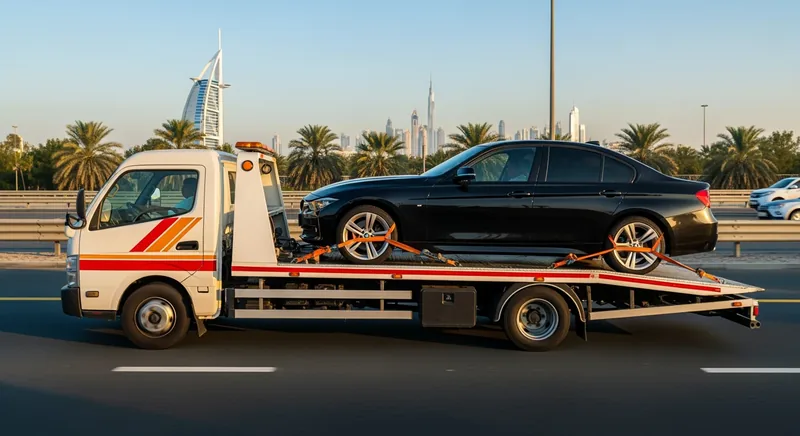
What car towing actually involves in Dubai
Car towing in Dubai is the dispatch of a tow truck to a vehicle and the safe transport of that vehicle to a destination — workshop, home, port, another emirate, or an insurance write-off yard. The destination dictates the rig type and the route. Short urban hops to a nearby workshop work well on a wheel-lift truck. Inter-emirate runs from Dubai to Abu Dhabi, RAK or Fujairah belong on a flatbed because tire heat damage on long highway tows is real. Towing for export at Jebel Ali Port follows different paperwork than towing for personal repair. Each route, vehicle and purpose has a matching technique.
The two towing methods we run
Almost every car towing job in Dubai uses one of two methods: flatbed or wheel-lift. They look similar from a distance — both are trucks with a hydraulic system at the back — but they work very differently. A flatbed tilts a 6-metre or 8-metre flat deck down to ground level, the vehicle is winched up onto the deck, and during transport all four wheels rest on the deck with no contact with the road. A wheel-lift raises only the drive wheels on a hydraulic underlift cradle, and the trailing two wheels remain on the ground rolling at road speed during the tow. Both are licensed and safe when matched to the right vehicle, but mismatching them to vehicle type can cause expensive damage.
When flatbed is the right choice
Flatbed is the universal safe answer. Use flatbed if the vehicle is: an electric vehicle (Tesla, Lucid, BYD, Polestar, Rivian, Mercedes EQ, BMW i, Audi e-tron — wheel-lift damages the regen brake system), an all-wheel-drive or four-wheel-drive vehicle (Land Cruiser, Patrol, Range Rover, X5, Audi quattro, Subaru — drivetrain bind risk), a supercar with a low front splitter (Ferrari, Lamborghini, McLaren, Aston Martin, lowered Porsche — bumper scrape on tilt), a vintage or classic car (paint and trim sensitivity), or any vehicle being towed more than 25 km (tire heat builds up on long hops and can cause tread separation on a wheel-lifted car). Flatbed is also the only safe option for vehicles that cannot roll — seized wheels, locked transmission, fully deflated tires, or accident-damaged.
When wheel-lift is the right choice
Wheel-lift wins on speed and access. Use wheel-lift if: the vehicle is a front-wheel-drive or rear-wheel-drive sedan in normal mechanical condition, the tow distance is under 25 km, the vehicle is in a tight basement parking with low ceiling clearance that a flatbed cannot enter, or the customer needs the fastest possible setup time. A wheel-lift truck can hook and lift a sedan in about 2–3 minutes versus a flatbed's 5–7 minutes. For a Toyota Camry being moved from a Bur Dubai apartment basement to a workshop in Al Quoz, wheel-lift is faster and slightly cheaper. The tow itself is also more manoeuvrable in tight urban streets because the tow truck plus vehicle is shorter and more agile.
The towing fleet we run
Our towing fleet includes standard 6-metre flatbeds for sedans, SUVs and short pickups, extended 8-metre flatbeds for longer pickups, panel vans, fleet trucks and double-stack motorcycle loads, low-clearance flatbeds with adjustable tilt angle for supercars and lowered cars, wheel-lift rigs for tight urban work, motorcycle-specific trailers with cradles for two-wheeler transport, and 10-tonne and 20-tonne heavy recovery rigs for trucks, buses and articulated lorries. Each truck is positioned at strategically distributed dispatch hubs across Dubai — Jebel Ali, Al Quoz, DIP, Mirdif, Marina, Deira — to minimise response time. The dispatcher routes the closest available rig that matches your vehicle type.
Vehicle classes and matching method
| Vehicle | Method | Why |
|---|---|---|
| Front-wheel-drive sedan (Camry, Corolla, Sentra) | Wheel-lift OK, flatbed safer | Standard mechanics, short distance fine on wheel-lift |
| Rear-wheel-drive sedan (BMW 3, C-Class) | Wheel-lift OK, flatbed safer | Same as above; flatbed for >25 km |
| All-wheel-drive (Land Cruiser, X5, Q7) | Flatbed only | Drivetrain bind risk on wheel-lift |
| Electric vehicle (Tesla, Lucid, BYD) | Flatbed only | Regenerative brake damage risk on wheel-lift |
| Supercar (Ferrari, Lambo, McLaren) | Low-clearance flatbed | Front splitter clearance, soft straps, paint protection |
| Pickup (Hilux, F-150, Ranger) | Standard flatbed | Length and weight need full deck |
| Motorcycle (sport bike, cruiser) | Motorcycle trailer with cradle | Soft strap from fork tubes, no chassis stress |
| Heavy truck (10 t+) | 10-tonne or 20-tonne recovery | Hydraulic underlift sized for axle weight |
Inter-emirate towing
One of the most common job types in our queue is inter-emirate transport — moving a vehicle from Dubai to Abu Dhabi, Sharjah, Ajman, RAK, Fujairah or UAQ, or any combination of those origin/destination pairs. We quote inter-emirate jobs at fixed rates per route to remove per-kilometre billing surprises. Common routes are Dubai–Abu Dhabi (140 km via E11), Dubai–RAK (140 km via E11), Dubai–Fujairah (130 km via Hatta or Sharjah-Kalba), and Dubai–Sharjah (15–30 km depending on Dubai origin). For all inter-emirate jobs we use flatbed — wheel-lift on a 100-km-plus highway run causes tire heat damage on the trailing wheels.
Towing from underground parking
Dubai's biggest tower communities — Marina, JLT, Tecom, Downtown, Business Bay, Bur Dubai, JVC — all have extensive underground basement parking. Some basements are shallow (one or two levels) and accept flatbed trucks; others go deep (B5+) with low ceiling clearance that only wheel-lift trucks can handle. The dispatcher asks two questions: "Which tower and which level?" and the answer determines rig dispatch. For example, Cayan Tower B3 has a low angled ceiling that blocks flatbeds — wheel-lift only. Princess Tower B5 has a 2.3-metre ceiling — wheel-lift only. Address Boulevard B5 has a 2.4-metre ceiling — wheel-lift only. We maintain a dispatcher reference table of every problematic basement in Dubai so we send the right rig the first time.
Loading procedure for sensitive vehicles
For supercars, vintage cars and EVs the loading procedure is slow and deliberate. Operator arrives, photographs the vehicle from all sides for pre-tow documentation, identifies the factory recovery points (printed in the owner's manual or marked with arrows under the bumper), positions the truck for a low-tilt-angle ramp approach, deploys soft cloth straps that grip the chassis without scratching paint, winches the vehicle slowly up the ramp under tension, secures the vehicle on the deck with four-point soft strapping, and re-photographs after loading. Total time is around 15 minutes versus 5 minutes for a standard sedan flatbed load — the extra time is non-negotiable for paint and chassis safety.
Loading procedure for accident-damaged vehicles
Accident vehicles need their own protocol. The vehicle has been moved by impact, recovery points may be damaged, fluids may be leaking, glass may be on the road, and the police report number must be in hand before the vehicle moves. Our operators carry chassis-rated recovery hooks, spreader bars, and rated soft shackles for damaged vehicles. We do not pull from cosmetic bumpers, tow eyes that are bent, or any point that looks marginal. For severely rolled or trapped vehicles we coordinate with our heavy recovery team and use a rotator crane to right the vehicle before flatbed loading.
Towing for export at Jebel Ali Port
Jebel Ali Port handles vehicle export across MENA and East Africa. Towing a vehicle to the port for export requires customs paperwork the customer arranges in advance — Bayan declaration, vehicle export form, and gate-pass for the recovery truck. We deliver to the port export yard and the buyer or shipping agent takes over from there. Common export routes are Dubai → Mombasa, Dubai → Dar es Salaam, Dubai → Jeddah and Dubai → Dammam.
Pricing variables
Five things move a tow quote. Vehicle type — sedans cheapest, supercars need low-clearance ramp and soft strapping (slightly more), heavy trucks need 10/20-tonne rigs (significantly more). Distance — short urban hops billed on a base + per-km schedule; inter-emirate jobs at fixed rates. Time of day — small night surcharge between midnight and 6 AM. Difficulty — urban tarmac is baseline; basement extraction adds time; accident scenes add coordination overhead. Extras — winch deployment, recovery boards for off-road, additional wait time at workshop or port, multiple-vehicle loads. Quote arrives on WhatsApp within 60 seconds of you sharing details, and there is no callout fee until you confirm.
Fleet contracts and B2B accounts
For companies with multiple vehicles — rental car operators, ride-share fleets, delivery operators, logistics firms, courtesy-car operators at workshops — we offer monthly contract billing with priority dispatch, dedicated account manager, fixed per-job rates, and monthly invoicing. Common B2B customers include rental car companies (we cover Hertz, Avis, Sixt, Budget, Europcar customer breakdowns under their corporate accounts), insurance assessors (we pre-position rigs near accident hotspots during peak hours), workshops (we provide courtesy-car relays and customer-vehicle pickup), and delivery fleets (Talabat, Careem, Deliveroo bike recovery contracts).
Insurance direct billing
Direct billing means you do not pay cash up-front for a tow that your insurance covers. We are partnered with AXA Gulf, Sukoon, Orient, Emirates Insurance and several smaller insurers. Send us a photo of your insurance card on WhatsApp before the tow and we coordinate with the insurer using your policy number. For accidents we also provide the police report copy and scene photos. Settlement happens between us and the insurer per their terms — you sign nothing on-site beyond a basic acknowledgement of the tow, and you do not handle paperwork.
Distance vs cost — the trade-off
For inter-emirate tows the question often comes up: "Should I drive it myself if it can still drive?" The answer depends on the underlying issue. If the temperature gauge climbed into the red on the way home, do not drive — you risk seizing the engine on the way to the workshop. If a fault code is showing but the engine runs cool, you can drive carefully to a nearby workshop in many cases. If the gearbox is slipping, do not drive — gearbox damage compounds rapidly. If you are unsure, send us a video on WhatsApp showing the dashboard warning lights and the symptom, and we will tell you honestly whether it is safe to drive or whether towing makes more sense.
What goes wrong on tows (and how we prevent it)
Three things can go wrong on a tow: paint damage from improper strapping, chassis damage from pulling on the wrong recovery point, or workshop misdelivery if the destination is unclear. We prevent paint damage with soft cloth straps and pre-tow photography (so any new damage is obviously new). We prevent chassis damage by training operators on factory recovery points for every common vehicle make and never improvising. We prevent workshop misdelivery by confirming the destination workshop name, address and Google Maps pin before the truck departs, and by sending a photo of the unloaded vehicle at the workshop entry to the customer.
Common questions about towing in Dubai
Can you tow at night? Yes — 24/7. Small night surcharge midnight to 6 AM. Can you tow during sandstorms? Yes, but visibility-related delays may extend ETA — we do not dispatch when the visibility drops below RTA-mandated minimums. Can you tow during Eid weekends or public holidays? Yes — we operate 365 days a year. Can you tow a non-running vehicle? Yes — we use the winch to pull onto the flatbed. Can you tow a vehicle without keys? Yes — the wheels do not need to be steered for flatbed loading. Can you tow a vehicle from a multi-storey parking? Yes — we send a wheel-lift if the basement clearance does not allow flatbed.
The number to save
For any towing situation in Dubai or across the UAE — short urban hop, inter-emirate transport, accident clearance, supercar move, fleet contract — the dispatch number is +971 56 361 3657. WhatsApp at wa.me/971563613657 for the fastest response. EN + AR support 24/7. Quote in 60 seconds. No callout fee until you confirm. Average arrival 30 minutes Dubai-wide. RTA-licensed, in-house fleet, 4.8-star rating from 281+ Google reviews.
Towing during sandstorms and bad weather
Dubai gets sandstorms and occasional heavy rain. Both create challenges for tow operations. Sandstorms reduce visibility on highways below RTA-mandated minimums for heavy trucks; we delay non-urgent dispatch during peak storm periods and prioritise customers in dangerous spots (highway shoulders, accident scenes). Heavy rain in Dubai is rare but can flood underpasses and low roads; tows through flooded sections are refused for safety. Wadi flash floods after rain in Hatta or Wurayah create real danger; vehicles stuck in moving water need specialist water-rescue, not standard recovery. We monitor the National Centre of Meteorology alerts and adjust dispatch accordingly. The customer always receives an honest update on WhatsApp if weather is delaying arrival — we never inflate ETA without explanation.