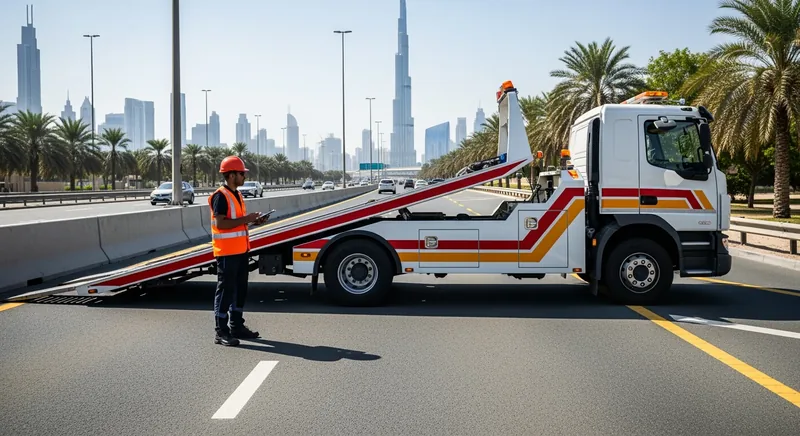
What "car recovery" actually means in Dubai
The term "recovery" gets used loosely in everyday conversation, but inside the industry it has a specific meaning. Car recovery is the dispatch of a specialised tow vehicle to a vehicle that cannot move under its own power and the safe transport of that vehicle to a workshop, home or another emirate. It covers everything from a dead battery in a Downtown parking lot to a Land Cruiser buried up to the differential in soft sand at Big Red. The "specialised" part matters — recovery rigs are not just regular tow trucks. They are flatbed trucks with hydraulic tilt decks, wheel-lift rigs with hydraulic underlifts, and 4×4 desert recovery vehicles with kinetic snatch straps and 12,000 lb winches. Each piece of equipment exists for a specific scenario.
Recovery vs towing — the technical distinction
In Dubai everyday speech the two words are interchangeable, but inside the industry there is a distinction. Towing typically refers to the transport of a working vehicle from one location to another — for example, moving a car from your home in Marina to a workshop in Al Quoz for service. Recovery implies that the vehicle has stopped working or has crashed, and the operation involves winching, lifting, or extracting the vehicle before transport begins. Both are covered by our service under the same WhatsApp number — same dispatch, same fleet, same operators. The reason we explain the distinction is so customers know what to expect: a "recovery" job often includes 10–15 minutes of preparation work (winch setup, recovery point identification, scene securing) before the vehicle actually moves, while a simple "tow" can have the vehicle on the deck and rolling within five minutes of the truck arriving.
Our flatbed fleet
Flatbed is the universal safe choice for car recovery. The hydraulic deck tilts down to ground level, the vehicle winches up onto the deck under tension, and once loaded all four wheels rest on the deck during transport. No drivetrain wear, no tire heat damage, no risk to AWD couplings, no regen-brake damage on EVs. We run flatbeds in two configurations — standard 6-metre deck for sedans, SUVs and vans up to 5 metres long, and extended 8-metre deck for longer pickups, panel vans and fleet trucks. For low-clearance supercars we use a low-tilt-angle ramp (around 8–10 degrees instead of the standard 14 degrees) so the front splitter and bumper clear the deck approach. For motorcycles loaded onto a flatbed we add a foldable wheel chock and four soft straps to secure the bike upright.
Our wheel-lift fleet
Wheel-lift rigs use a hydraulic underlift that grips the drive wheels and raises them off the ground while the trailing wheels remain rolling. They are faster to deploy than flatbeds (around 2–3 minutes versus 5–7 minutes), they fit into tighter basement parking with low ceiling clearance, and they cost slightly less per job. The trade-off is that they are not safe for all vehicle types. We never use wheel-lift on electric vehicles (regenerative brake damage), all-wheel-drive cars (drivetrain bind), supercars with aggressive front splitters (bumper scrape on tilt) or any non-rolling vehicle where the trailing wheels cannot turn freely. For front-wheel-drive sedans on short urban hops, wheel-lift is the right tool. For everything else, flatbed.
Twelve specific recovery scenarios we handle
Below are the most common situations we get dispatched for in Dubai, in rough order of frequency:
- Dead battery — won't start in a parking lot. Often we resolve on-spot with a jump pack and the customer drives away (no recovery needed).
- Mechanical failure — engine seized, gearbox stuck in gear, alternator dead. Flatbed transport to workshop.
- Accident — minor or major collision. Police report, scene clearance, flatbed to insurer-approved workshop.
- EV failure — Tesla in tow mode, Lucid won't power on. Always flatbed-only, never wheel-lift.
- Lockout — keys inside, smart key dead. Usually resolved on-spot with non-destructive tools (no tow needed).
- Out of fuel — empty tank. Roadside fuel delivery resolves on-spot.
- Flat tire — puncture or blowout. Spare fitted on-spot or temporary plug repair.
- Sand stuck — Land Cruiser, Patrol, Wrangler stuck in dunes. 4×4 desert recovery rig with snatch strap.
- Inter-emirate move — moving a car from Dubai to Abu Dhabi, Sharjah, RAK or Fujairah for sale, workshop or relocation. Fixed-rate flatbed.
- Supercar transport — Ferrari, Lambo, McLaren, Bentley, Rolls. White-glove flatbed with low-clearance ramp and soft straps.
- Motorcycle recovery — sport bikes, cruisers, scooters, delivery bikes. Specialised cradle and soft straps.
- Heavy vehicle — articulated lorry, bus, tanker, plant equipment. 10-ton or 20-ton recovery rig with underlift or rotator.
How a typical recovery call unfolds
Step one — customer message. WhatsApp arrives with a live location pin, a brief description of what's wrong, and ideally a photo of the vehicle. Step two — dispatcher triage. Within 30 seconds the dispatcher identifies the right rig type, picks the closest available unit, and sends a transparent quote. Step three — customer confirmation. Once you approve the quote on WhatsApp, the truck departs. Step four — live ETA. The dispatcher updates you every few minutes with the truck's position. Step five — operator pre-arrival call. Five minutes before reaching you, the operator phones to confirm exact loading point, gate access, parking level if applicable. Step six — arrival and loading. Operator arrives, secures the scene, identifies the vehicle's recovery points, deploys the winch or ramp, and loads the vehicle. Step seven — transport. The vehicle moves to the agreed destination. Step eight — unload and pay. Vehicle is unloaded, you inspect for any new damage (rare with proper soft-strap technique), payment is processed, and a written WhatsApp invoice with photos arrives.
Where breakdowns concentrate in Dubai
Across all our dispatch data over the last 12 months, breakdowns concentrate in five predictable locations: Sheikh Zayed Road (the highest single-road volume — heat, traffic, mixed vehicle ages), Al Khail Road (commuter corridor, high speeds, heavy lane changes), basement parking in Marina towers (Tesla and EV battery faults, low-ceiling lockouts), Downtown valet zones (supercar dead batteries from sitting too long), and weekend desert exits at Al Awir (Land Cruisers stuck in soft sand). Knowing this concentration shapes our dispatch — we keep more rigs near these zones during peak hours.
Operators and training
Every recovery operator on our team holds a UAE Class 4 commercial driving licence (Class 5 for heavy recovery), an RTA-issued towing permit, and has been through our internal training programme covering: damage-free loading technique, soft-strap usage for paint protection, EV-specific handling protocols (no rolling tow ever, manufacturer tow-mode procedures), supercar low-clearance handling, accident scene safety and police coordination, desert recovery with kinetic snatch straps, motorcycle cradle technique, and customer communication on WhatsApp. Operators are full-time employees — we do not subcontract to independent drivers. This is the only way to guarantee that the operator who arrives at your vehicle has been trained on the specific procedures that apply to your make and model.
Equipment we carry on every truck
Standard kit on every flatbed: hydraulic tilt deck with anti-skid surface, 5-tonne electric winch with synthetic line, four soft straps (1-tonne working load each, paint-safe), two heavy-duty ratchet straps, wheel chock, hazard cones and warning triangles, portable lithium jump pack (handles 12V batteries up to 8 litres engine size), obd-II diagnostic scanner for quick fault triage, tire repair kit with plugs and 12V compressor, 5-litre fuel jerrycan (petrol), recovery boards (for off-road jobs), kinetic snatch strap and soft shackles (for off-road), first-aid kit, and a fire extinguisher. For EV-specific calls we carry the manufacturer-recommended tow-mode reference cards for Tesla, Lucid, BYD and Polestar. For motorcycle calls we add a foldable wheel chock and four extra soft straps sized for bike fork tubes.
Insurance, claims, and direct billing
For accident jobs the police report number is the critical document — every UAE insurer requires it and we cannot move a damaged vehicle from an accident scene until it is issued. We coordinate with Dubai Police (call 999 yourself or we can place the call on arrival), wait for the report, photograph the scene, and forward the report number plus photos to your insurer using your policy number. For our partner insurers — AXA Gulf, Sukoon, Orient, Emirates Insurance — direct billing means you do not pay cash up-front and the insurer settles with us per their policy terms. For non-partner insurers, you pay us directly and reclaim from your insurer using the invoice and police report we provide. Either path, the paperwork is straightforward.
Pricing — how we quote
The five variables that move a recovery quote are: vehicle type (sedan vs SUV vs supercar vs heavy truck), distance (origin to destination, billed per kilometre or fixed-rate for inter-emirate), time of day (small night surcharge between midnight and 6 AM to cover overtime operator pay), difficulty (urban tarmac vs desert sand vs mountain road vs accident scene), and extras (winch deployment, recovery boards, scene clearance, additional waiting time). Each is priced separately and the dispatcher rolls them into a single quoted figure on WhatsApp before any truck moves. There is no callout fee — if you decline the quote, you owe nothing and the truck does not depart. Repeat customers and fleet accounts can request standard quote templates so the same job type always quotes consistently.
Common mistakes drivers make during a breakdown
The most expensive mistake is continuing to drive a non-running car. If the engine seizes, the gearbox locks, or the temperature gauge climbs into the red, pull over immediately. Driving another kilometre to "get home" can multiply the workshop bill by ten. The second mistake is standing on the traffic side while waiting — every recovery operator has stories of near-misses with drivers who exited their car onto the highway shoulder facing into traffic. Always step out kerb-side. The third mistake is refusing to share the police report number with the recovery operator after an accident. The operator needs it to legally move the vehicle, and the insurer needs it to process the claim. Finally, do not attempt amateur recovery in deep sand or on a slope. Pulling from the wrong recovery point on a Land Cruiser can rip out the bumper or buckle the chassis, turning a 30-minute tow job into a workshop write-off.
What we do not do
For the sake of clarity we should also list what we do not do. We do not perform vehicle repairs at the workshop — we transport to your chosen workshop or to a workshop we recommend, but the actual repair is the workshop's job. We do not store vehicles long-term — we drop off and leave. We do not handle insurance disputes on your behalf beyond providing the recovery invoice and police report copy. We do not perform paintless dent repair, panel beating or mechanical work at the roadside (other than the limited diagnostic and quick-fix scope of roadside assistance). And we do not dispatch unmarked vehicles — every Car Recovery Dubai truck has visible branding, valid plates and a uniformed operator with company ID.
Why customers come back
Repeat customers — and we have a lot of them — come back for three reasons. Predictability: same number, same dispatch, same standards. Honesty: the quote is the price, no surprises. Communication: WhatsApp keeps the customer informed at every step, with photos and live ETAs that traditional phone-only operators cannot match. We have customers who have used us six or seven times across multiple vehicles, and we have B2B fleet accounts where the relationship has run for years. The compound effect of treating every job like the customer might call again is what built our 4.8-star Google rating from 281+ reviews. The number to save right now is +971 56 361 3657 — the same WhatsApp and phone line works 24 hours a day, 365 days a year.
How to verify a recovery operator is legitimate
Before any recovery truck arrives, you can verify the operator legitimacy in three quick checks. One: the truck should have visible Car Recovery Dubai branding and registered UAE plates. Two: the operator should be wearing branded uniform with photo ID badge clipped on. Three: the WhatsApp quote you received should match the verbal quote given on arrival — no surprise charges. Any operator asking for cash before showing identification, or arriving in an unmarked truck without ID, is not us. We have had isolated reports of opportunists picking up stranded drivers in unmarked trucks at accident scenes; if anyone approaches you and you did not call them via our published number, refuse and call 999 for police. Our published number is the same one you message via WhatsApp: +971 56 361 3657, and that number alone routes to our dispatch.