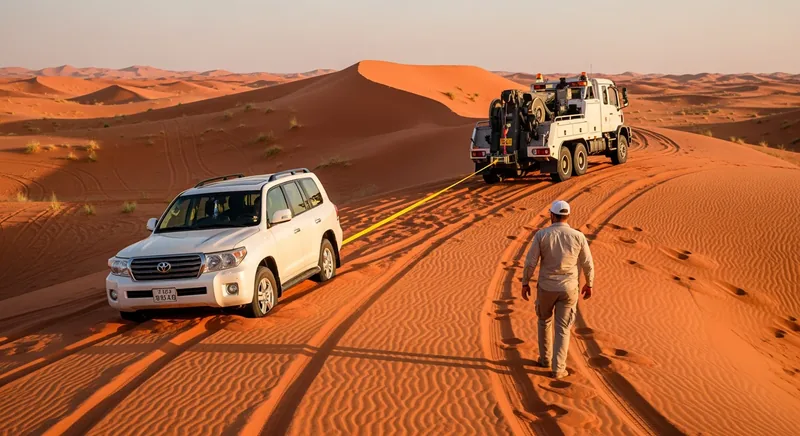
Why desert recovery is a different discipline
Desert recovery is not the same as urban recovery. The vehicles are different (heavy 4×4s instead of sedans), the terrain is different (soft sand, dune slopes, rocky wadis instead of flat tarmac), the equipment is different (kinetic snatch straps and 12,000 lb winches instead of standard tow hooks), and the navigation is different (GPS coordinates instead of street addresses). A driver who got their Land Cruiser stuck in Big Red on a Friday afternoon needs a recovery operator who has been to Big Red dozens of times, knows which dunes are climbable in which conditions, knows where the firmer ground is to position the recovery vehicle, and carries the right kit for soft-sand extraction. Desert recovery in Dubai is a specialist discipline within the broader recovery service.
The Dubai dune zones we cover
The most common desert recovery destinations in our dispatch log:
- Big Red (Al Hamar dunes) — the easiest desert access from Dubai, just off E66 about 35 km east of the city. The "Big Red" dune itself rises to around 100 metres. Family weekend dune-bashing destination. About 30 minutes' drive from our nearest dispatch hub.
- Faya (Pink Rock) — slightly further east, off E44. Mixed terrain — rocky outcrops and softer sand pockets between them. Popular with experienced 4×4 owners and tour operators.
- Lahbab — off E44, larger dune system, moderate difficulty. Many tour operators stage from Lahbab Road. About 45 minutes from Dubai dispatch.
- Margham — south of the city, accessed via E611. Quieter, more remote, larger dune systems. Recovery here can take 50–70 minutes from Dubai dispatch.
- Al Lisaili — far south, near Endurance City and the camel race course. Remote desert access. Recovery takes 50+ minutes.
- Hatta wadi system — east of Dubai near the Oman border. Different terrain (rocky valleys, water crossings) but same recovery skill set required.
- Sharqiya / Sweihan — Abu Dhabi side, accessed from Sweihan Road. Larger and more remote dunes. Recovery from Dubai takes 90+ minutes; we can dispatch from our AD-side staging if available.
- Al Maha / Al Marmoom Conservation Reserve — controlled-access conservation area. Recovery within the reserve requires reserve coordination.
The science of getting stuck
Most desert stuck situations come from one of four causes: losing momentum on a dune climb (the most common — the engine bogs down halfway up, the wheels start spinning, and the vehicle settles into the sand), going down a dune at the wrong angle (cresting a sharp ridge and burying the front bumper or rolling), driving in deep soft sand without deflating tires (high tire pressure narrows the contact patch and causes the wheels to dig in), and following an inexperienced lead driver off a known track into untested terrain. The recovery solution depends which cause applies.
Tire deflation — the single most important step
Before any kinetic snatch strap pull, the first thing our recovery operator does is deflate the stuck vehicle's tires. Standard road pressure of 32–35 PSI gets reduced to 12–15 PSI for soft sand. Lower pressure widens the tire footprint, increases the contact patch area on the sand, and dramatically reduces the resistance to forward motion. In many cases, deflation alone allows the stuck vehicle to drive itself out without the snatch strap being needed. After recovery, the operator re-inflates the tires using a portable 12V compressor before the customer drives away on tarmac — running road tires at 12 PSI on the highway is dangerous.
Kinetic snatch straps — the workhorse
The standard tool for soft-sand extraction is the kinetic snatch strap. Unlike a static tow strap, a kinetic strap is made of stretchy nylon webbing that elongates 15–25% under tension and rebounds. The recovery vehicle accelerates away from the stuck vehicle, the strap stretches, stores energy, and snaps back — transferring the energy to the stuck vehicle in a smooth pulse that breaks it loose without the violent shock load that a static strap would deliver. Kinetic straps are gentler on the chassis mounts of both vehicles. We carry rated 30,000 lb kinetic straps, soft shackles (synthetic-fibre — they cannot become projectiles if they snap, unlike steel shackles), and recovery boards as backup.
Winches and snatch blocks
For severe stuck situations — deep burial, slope where the recovery vehicle cannot park above the stuck vehicle, or rocky terrain where snatch straps risk damage — we deploy the winch. Our recovery 4×4s carry 12,000 lb electric winches with synthetic line. Synthetic winch line is preferred over steel cable in modern recovery for several reasons: it does not store as much energy when under tension (so if it snaps, it falls instead of recoiling dangerously), it weighs about a third of equivalent steel, and it does not develop barbed broken strands that injure hands during handling. For situations needing more pulling force than the winch alone provides, we deploy a snatch block — a heavy-duty pulley that doubles the effective pulling force of the winch by routing the line back to a fixed anchor point.
Recovery boards
For shallow stuck situations or as the final stage of a deeper recovery, recovery boards (sometimes called sand ladders) are placed under the driven wheels to provide grip and lift the wheel out of the depression. Modern boards are reinforced plastic with aggressive teeth on both sides; Maxtrax, Tred and Stockton are common brand names. The driver gently applies throttle, the wheel grabs the board, and the vehicle drives forward onto firmer sand. Two-board recovery on the front wheels is enough for most front-wheel-driving 4×4s; four-board recovery on all wheels for full 4WD bog situations.
Working with GPS, what3words and live location pins
Sharing your exact location is the single biggest variable in dispatch time. Landmark-based descriptions ("near the second blue flag past the camel farm") fail in featureless dunes — GPS coordinates or what3words addresses do not. Best options in order of preference:
- WhatsApp live location pin — one tap on iOS or Android, updates every minute as the recovery vehicle approaches.
- what3words address — three-word combination that maps to a 3 m × 3 m square anywhere on Earth. Free app, works offline.
- GPS coordinates — latitude and longitude in decimal format. Can be read off any GPS or Google Maps screen.
- Detailed landmark — last-resort, only useful when combined with one of the above.
Our recovery vehicles all have sat-nav with offline desert map packs, paper map backups, and dead-reckoning compass training for situations where GPS fails (rare in modern times but possible in deep canyons or near electromagnetic interference).
Equipment checklist on every desert recovery rig
- 30,000 lb kinetic snatch strap (paint-safe nylon)
- 10-tonne rated soft shackles ×4
- 12,000 lb electric winch with synthetic line and remote
- Snatch block / recovery pulley
- Recovery boards (4 boards minimum)
- Tyre deflators (preset to 15 PSI)
- 12V tyre inflator (compressor) — 2-cylinder for fast post-recovery inflate
- Spreader bars and chassis-rated recovery hooks for damaged vehicles
- Hi-lift jack and jacking base plate (for sand-stable jacking)
- Spade and folding shovel for clearing sand around buried wheels
- Sat-nav with desert map pack, paper map backup, compass
- Satellite messenger (Garmin inReach) for areas with no mobile signal
- 20-litre water reserve, ration pack, first-aid kit, fire extinguisher
Specialised recoveries we handle
Beyond standard sand extraction, we handle several specialist scenarios. Rolled vehicles on dune faces — we use winch with rigging to right the vehicle before flatbed loading. Tour operator dune buggy and quad bike recovery — smaller cradle and trailer setup; we have standby contracts with several Dubai tour operators. Wadi water rescue — vehicles stuck in shallow water after rain in Hatta or Wurayah; we use long winch line from solid ground. Mountain road descent failures — overheated brakes on Jebel Jais descent; we deploy from RAK staging and can transport down the mountain on flatbed. Endurance event support — pre-positioned standby vehicles at Lisaili camel races and 4×4 club gatherings.
Mistakes that turn a quick recovery into an expensive one
The most expensive mistake is continuing to spin the wheels after first getting stuck. Spinning wheels dig the vehicle deeper, melt the sand under the tire (especially in dry hot dune sand), and can damage the differential or transmission. The moment you feel the vehicle lose forward momentum, stop. The second mistake is amateur recovery using the wrong recovery point. Pulling from a tow ball, a cosmetic bumper, a tow eye that is bent, or a non-rated point can rip the bumper off, buckle the chassis or, in severe cases, snap a hard component that becomes a projectile. The third mistake is using the wrong type of strap. A static tow strap on a kinetic snatch pull will transfer too much shock load and may damage chassis mounts. Use kinetic for snatch pulls.
Heat and hydration during desert recovery
Desert recovery in Dubai summer is genuinely dangerous if you are unprepared. Daytime temperatures in Big Red or Lahbab can exceed 50°C, vehicle interiors without AC reach 65°C+, and dehydration onset is fast — symptoms include headache, confusion and physical weakness within a couple of hours. Our operators carry water reserves and emergency rations on every desert call. While waiting for the recovery to arrive, stay in your vehicle with the AC running if the engine can run, drink water if you have it, and avoid walking in the sand under direct sun. Tell the dispatcher how many people are in the vehicle and any medical conditions so we prioritise correctly if you are at heat-stress risk.
Pricing — desert vs urban
Desert recovery pricing reflects the equipment, distance and operator skill premium. The job typically includes: long drive to and from the dune zone, time on-site for setup and recovery, wear and tear on specialised equipment, and a small night surcharge for after-dark calls (visibility kit and additional safety setup). For convoy events and tour operator standby contracts we offer fixed-rate seasonal pricing. Quote arrives on WhatsApp within 60 seconds of you sharing the GPS coordinates and vehicle details.
Tour operators and standby contracts
Several Dubai tour operators — desert safari companies, dune-buggy outfits, quad-bike operators — keep us on standby for backup recovery during their tours. The operator pre-pays a monthly retainer and we hold a recovery vehicle near their staging area during operating hours. When a customer vehicle in their tour gets stuck, we are on-scene within 15 minutes instead of an hour. If you run a tour operation in the Dubai or Abu Dhabi desert, contact us via WhatsApp to discuss a standby contract.
What to bring on every desert trip
Self-sufficiency reduces your risk of needing professional recovery. The minimum kit for any Dubai dune trip: tire deflator and 12V compressor (deflate to 15 PSI before going off-road, re-inflate to road pressure on exit), recovery boards (the cheapest insurance you can buy), at least 4 litres of water per person, fully charged mobile phone with offline desert maps, let someone know your route and ETA before going off-road. Drivers in the Dubai 4×4 community who carry this minimum kit handle most stuck situations themselves and only call recovery for situations beyond their kit.
The number to save before you head out
Save +971 56 361 3657 in your phone before your next desert trip — there is no point looking up our number when your battery is dying in the dunes. WhatsApp at wa.me/971563613657 with your GPS coordinates or what3words address. EN + AR dispatch 24/7. Average arrival to Big Red 30 minutes, Lahbab 45 minutes, Margham 50–70 minutes, deep desert 70+ minutes. RTA-licensed, properly equipped, full insurance — and the only Dubai recovery operator with dedicated desert kit on every off-road dispatch.
Convoy etiquette — keep the recovery operator's job simple
If you are part of a 4×4 convoy and one vehicle gets stuck, the convoy should follow these rules until our recovery rig arrives. Stop the convoy immediately in a safe spot above or beside the stuck vehicle — do not keep driving and abandon the stuck driver. Do not attempt amateur recovery with another convoy vehicle unless one of the convoy is genuinely experienced and properly equipped (rated recovery points, kinetic snatch strap, soft shackles). Pulling from a tow ball or non-rated point can launch the bumper into the air and seriously injure people. Mark your position for the inbound recovery vehicle — convoy hi-vis flag, parked vehicle as a marker, or share live location pin. Stay hydrated and out of direct sun. The recovery operator works faster when the convoy is calm, organised and out of the way.